
Culture capability and organisation
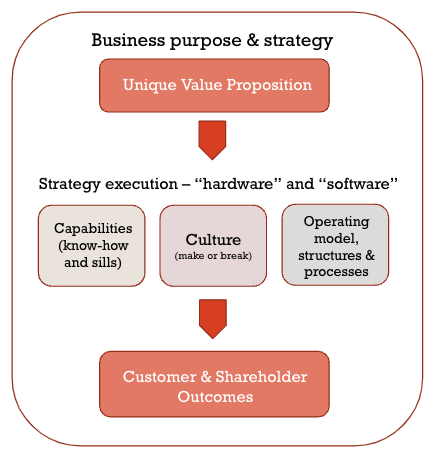
Culture, and its associated behaviours, is at the heart of an integrated system of factors that determine how successfully strategy is executed. The diagram provides a simple illustration.
Burke & Litwin’s well known model of organisational performance and change (1992) highlights this complexity and draws attention to how both “soft” and “hard” elements of organisation need to align to ensure the system works well as a whole and is able to adapt to change (external and internal). Many other whole system and congruence theorists support this view e.g. Nadler & Tushman, Senge, Snowden.
So whilst culture is a critical and transformational success factor, clearly it is not the only thing that matters – creating the right culture, aligned to strategy, is a necessary but not sufficient condition to drive sustainable business performance.
What I wanted to highlight on this page is a way of simplifying this complexity which helps to join the dots and create a broader roadmap for strategy execution – what many professionals in the field would refer to as the practice of organisation development or organisation effectiveness.
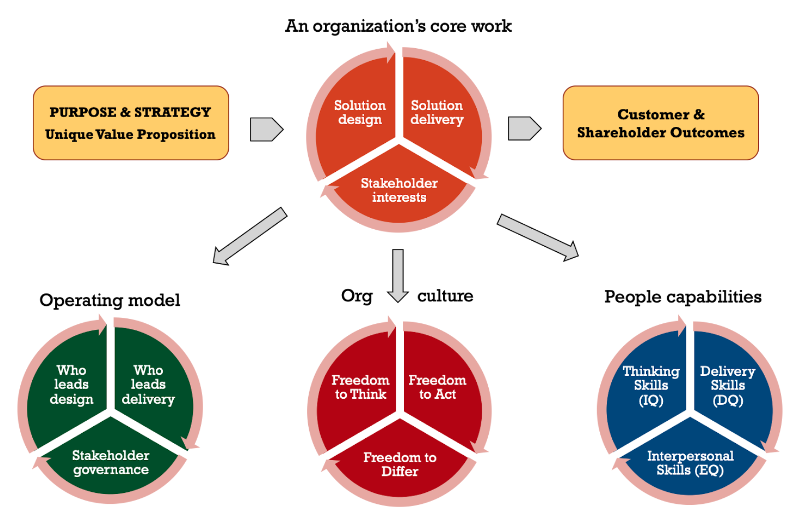
The key to this simplicity is the same solution development and delivery cycle which I’ve used as the basis for the Org Culture Framework. In my view it also works very well as the basis for operating model design, and the definition of core people capabilities. This is how:
Operating model
The big questions that need to be answered in relation to organisation design are:
- Which business areas lead/support on the development of an organisation’s unique value proposition (its “solutions”)
- Which business areas lead/support on the delivery of this proposition.
Answers to these “who leads/supports” questions clarify business area accountabilities and decision making remits for an organisation’s core value chain (high level org design), and then at a more granular level the processes and ways of working that relate to the execution of these accountabilities/decisions (detailed org design).
In my experience these more detailed questions involve discussions around the same leadership dilemmas that are the basis for the Org Culture Framework e.g. to what extent are local teams involved and consulted in the development of solutions; and in the delivery phase what degrees of freedom do local teams have to customise global solutions for local audiences. These are the same “loose/tight” or “degrees of freedom” questions that need to be answered in relation to required culture, and the connection between the mechanics and organics of an organisation is clear. Refer to the diagram below for a graphic illustration of how these elements align.
A further important question to address is who makes decisions, and what the guiding principles are for these decisions, when the interests of customers and owners are in tension e.g. whether to raise prices to increase profits when a competitor exits a market. And this dilemma relates to the stakeholder management issues bound up with the upward looking vs. outward looking dynamics that are part of the Freedom to Differ culture area.
In my experience, a lot of organisation design work progresses too quickly into the tactical consideration of spans and layers without first addressing these more fundamental org design points linked to the effective execution of strategy.
People capabilities
The solution development and delivery cycle is fundamentally about the work that gets done in an organisation; and the tasks that make up this work require skills and knowledge. In my experience the overwhelming majority of skills or competency frameworks in use in organisations can be mapped back to three core areas – and these areas are about the thinking skills (IQ) needed to develop solutions, the delivery skills (DQ) needed to deliver solutions, and the inter-personal skills (EQ) needed across this work cycle to manage the often conflicting interests of an organisation’s various stakeholder groups. Underpinning these “core skills” is the technical knowledge needed to carry out different functional specialities, but this know-how is always applied through the agency of people’s “core skills”.
This can be depicted in relation to the same model which pivots off the work that people do – see above. HR, OD and L&D professionals often talk about people needing the right mindset and skillset to get work done effectively, and this model not only provides a way of aligning culture to capability, but also the key questions of organisation design.