
Org Culture Research
The Org Culture Framework, and data from the associated Org Culture Survey, provide the opportunity to test a number of hypotheses that relate the dimensions of culture to a range of outcomes – organisational performance, agility & innovation, as well as measures of employee sentiment. A set of initial hypotheses are set out below, but I’d very much welcome ideas from experts and academics in the field on additional avenues for investigation.
What’s missing at the moment is two things. Firstly data. This depends on enough people using the Org Culture Survey tool, and the organisations that they work for being willing to allow the use of this data on an anonymous basis for research purposes. And secondly the services of researcher, or research team, with the interest, time and skills to formulate and carry out the relevant statistical tests.
If you are business school faculty, or a potential PhD student with a keen interest in taking forward research in this area, I’d be delighted to hear from you. Please just get in contact by sending me a message using the following email address: enquiries@orgcultureproject.com.
In the meantime, please feel free to go to the community page to comment on the following research hypotheses:
1. Culture and business performance hypotheses:
- The smaller the gaps between Current and Required culture, the higher the level of business area performance
- Scores that are too low on FtD (score averaged across the four FtD dimensions) will undermine longer-term sustainable performance; scores that are too high on FtD will undermine short term performance
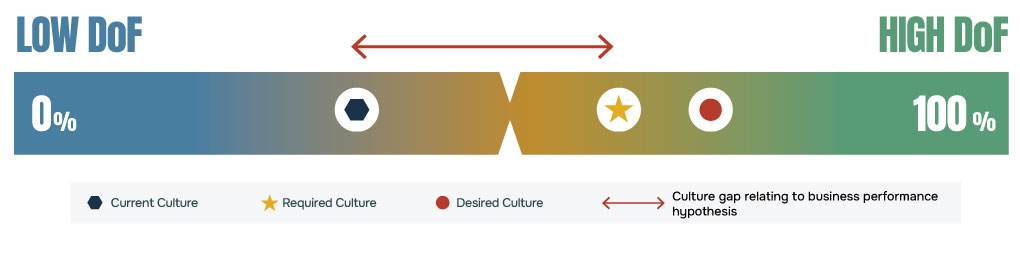
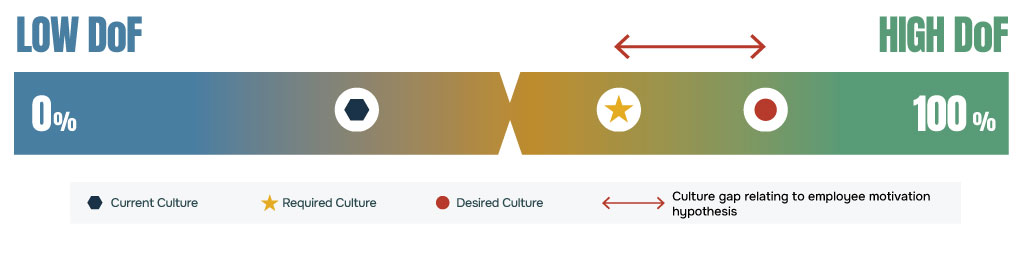
2. Culture and employee motivation/ wellbeing hypothesis:
- The smaller the gaps between Current and Desired culture, and Current and Required culture, the higher the levels of employee work satisfaction, motivation and wellbeing
N.B. Standard measures of employee work satisfaction are scores on eSat, discretionary effort, intent to stay and employer recommendation from an organization’s regular employee survey.
3. Cultural flexibility (And/Or) hypotheses:
- Each of the 12 culture dimensions can vary separately (AND), but a business area will struggle to demonstrate ways of working at both ends of a single dimension simultaneously (OR). N.B. It is likely that this hypothesis will need to be researched both qualitatively and quantitatively.
- Scores on the FtD dimension, particularly the Leadership Style dimension, will affect the degree of variance of scores on the FtT and FtA dimensions. Low degrees of freedom on FtD will lead to low levels of variance on the scores for the FtT and FtA dimensions. Conversely, high degrees of freedom on FtD will lead to high levels of variance on the scores for the FtT and FtA dimensions.
4. Organisational innovation and agility hypothesis:
- Higher scores on the FtD dimension will drive higher levels of organisational innovation and agility