
Culture Change – Principles & Approach
On this page I will summarise the four principles that define my approach to changing culture based on the Org Culture Framework. For more information on the practicalities of designing and delivering team interventions, including an outline for a typical intervention, please refer to the Practitioner Guidance page.
Principle 1
Leader’s openness and commitment are vital
The first principle is that the unit of culture change is a team, and that the team’s leader must be open to change at a personal level. Due to the positional authority of a leader – and their over-riding influence on behavioural norms and habits in the team (the “strong vertical force”) – any attempt to change culture in a business area without their full commitment is very difficult, if not futile. So the leader of a team is the starting point for initiating any intervention, and their team of direct reports is “first base” in terms of agreeing to and effecting changes to ways of working. From this basic unit, further changes and alignment can then be sought with inter-connected teams – both vertically (upwards and downwards) and horizontally (upstream and downstream).

Principle 2
Required culture should be agreed
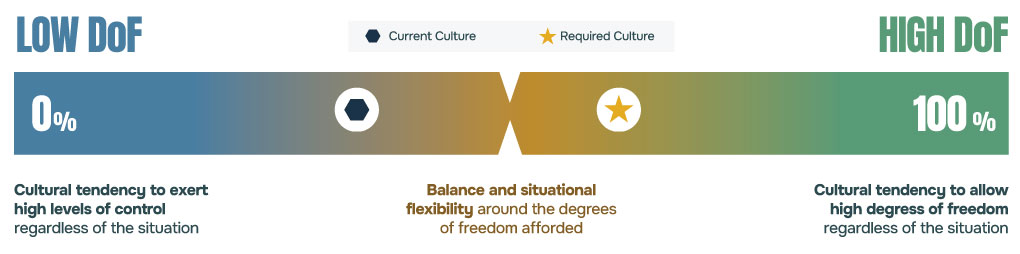
The second principle is that the “required culture” for the team in question needs to be decided in the context of that team’s role in the organization’s operating model and strategy. Using the Org Culture Survey tool, perspectives can also be gathered from outside the team in the same way as a 360 feedback exercise. This is a core part of any culture change intervention as it sets target culture in relation to the 12 dimensions, or the 3 culture clusters (FtT, FtA, FtD). For the sake of simplicity, it is recommended that a single point on each culture dimension is decided by the team’s leader following a discussion with the team, although selecting a “required culture” range is also a possibility.
Principle 3
Gap closure is the principal aim
The third principle is that the main goal of a culture change intervention using this approach is to close any significant gaps between current culture (as perceived by the survey participants) and required culture. If desired culture is also measured – an option using the Org Culture Survey tool – then gaps between desired and required culture should also be understood and reconciled. The role of the team’s leader in this process is to create an environment of psychological safety so that people feel able to say what they really think and feel, and facilitate this process of alignment. If this is done successfully, this should create the cultural conditions for sustainable team performance.
Leaders Role – Facilitating Alignment
